Sunday, March 8, 2009

Days Eleven and Twelve- March 7/8


Mark 8:36-28
For what will it profit them to gain the whole world and forfeit their life? Indeed, what can they give in return for their life? Those who are ashamed of me and of my words in this adulterous and sinful generation, of them the Son of Man will also be ashamed when he comes in the glory of his Father with the holy angels.’


Reflection

Pardon the pun, but these verse really are the crux of the matter, when it comes to Jesus' message to us in this passage. Really, all our attempts to save our lives are futile. Discipleship really is a reflection of who the Messiah is, one who gives his live away. When we walk with Christ in paths of love and service, we find such meaning and purpose and depth of living. Love truly isn't love unless we give it away.

Prayer
We praise you God, giver of live, who loves us and sacrifices in ways that offer us abundant life. Grant us the courage to give ourselves away...for you. Amen.

Friday, March 6, 2009

Day Ten- March 6


Mark 8:33

But turning and looking at his disciples, he rebuked Peter and said, ‘Get behind me, Satan! For you are setting your mind not on divine things but on human things.’

Reflection

Poor Peter! Such harsh words of rebuke were directed at him. Don't forget that Peter had just confessed, moments earlier in verse 29, that Jesus was the messiah, and yet Jesus calls Peter Satan. It was Satan who set out to change Jesus' course at the beginning of his minstry with temptations galore. Peter was surely responding to Jesus from his loving heart. No one wants to see a beloved suffer.

Setting our minds on divine things rather than human ones is Jesus' word to Peter, and to us. Setting our mind on divine things, like love and grace, would certainly alter our perspectives and our days. It's easy to say, though hard always to do, but it's a compelling Lenten practice to work on setting our minds on divine things.

Prayer

O God, when I cannot find the words and when I will not: when it is distracting and difficult to set my mind on divine things, embrace me in my humanness, hear my prayer, and help me to set my heart on you. Amen.


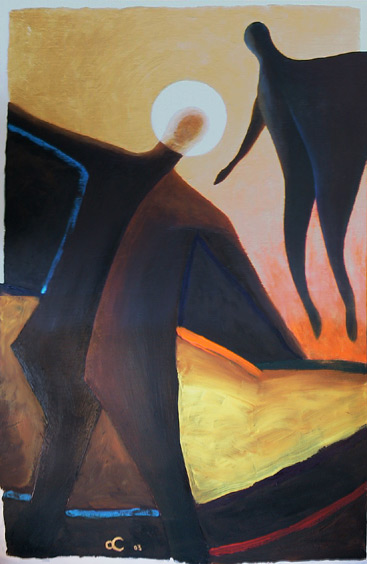
art: Wisdom's Path by Jan Richardson

Thursday, March 5, 2009

Day Nine- March 5


Mark 8:31-33

Then he began to teach them that the Son of Man must undergo great suffering, and be rejected by the elders, the chief priests, and the scribes, and be killed, and after three days rise again. He said all this quite openly. And Peter took him aside and began to rebuke him. But turning and looking at his disciples, he rebuked Peter and said, ‘Get behind me, Satan! For you are setting your mind not on divine things but on human things.’

Reflection

"Get thee behind me, Satan!" are famous words from this passage. It must have been so embarrassing and so very troubling for all concerned to witness this scene.
The disciples learn from Jesus that he must undergo great suffering.
Peter rebukes Jesus. ("Say it isn't so!")
Jesus rebukes Peter. ("You just don't get it.")

I'm not sure we would "get it" either. Who would hear past suffering, rejection and death and catch the part about resurrection? And for those early followers of Jesus, a messiah or savior was a leader, almost like royalty.
The notion of a suffering savior was a new and seemingly unacceptable thing.
Perhaps these verses invite us to think about our own preconceptions, assumptions and predispositions. ("This isn't how I thought it would be!" "That's not how it's supposed to go!") Perhaps these verses invite us to think about the assumptions we make that get in the way of receiving news of resurrection...

Prayer
O God, it's such an honor to be included among your co-workers that when you first invite us, it's hard to resist gasping, "You mean us? Why yes, we'd be glad to join in !" But your original approach is usually open-ended. You don't give us much idea of what we're really in for, except of course that we'll be coming alongside you. Then when you do get down to specifics, we're often so revolted that we want to get out of the whole thing. O God, thank you for sticking with us even when we run away. Convince us of your goodwill and wisdom. Enable us to be faithful to you. Through Jesus Christ. Amen.

(Opening to God: Childlike Prayers for Adults by Marilyn McCord Adams; Westminster John Knox Press, 2008. p. 43.)
Line drawing from worship works lectionary art.

Wednesday, March 4, 2009

Day Eight-March 4


Romans 4:13-25

For the promise that he would inherit the world did not come to Abraham or to his descendants through the law but through the righteousness of faith. If it is the adherents of the law who are to be the heirs, faith is null and the promise is void. For the law brings wrath; but where there is no law, neither is there violation.
For this reason it depends on faith, in order that the promise may rest on grace and be guaranteed to all his descendants, not only to the adherents of the law but also to those who share the faith of Abraham (for he is the father of all of us, as it is written, ‘I have made you the father of many nations’)—in the presence of the God in whom he believed, who gives life to the dead and calls into existence the things that do not exist. Hoping against hope, he believed that he would become ‘the father of many nations’, according to what was said, ‘So numerous shall your descendants be.’ He did not weaken in faith when he considered his own body, which was already as good as dead (for he was about a hundred years old), or when he considered the barrenness of Sarah’s womb. No distrust made him waver concerning the promise of God, but he grew strong in his faith as he gave glory to God, being fully convinced that God was able to do what he had promised. Therefore his faith‘was reckoned to him as righteousness.’ Now the words, ‘it was reckoned to him’, were written not for his sake alone, but for ours also. It will be reckoned to us who believe in him who raised Jesus our Lord from the dead, who was handed over to death for our trespasses and was raised for our justification.

Reflection
Christianity, Judaism and Islam all recognize our deep ties to Abraham, so much so that all three faiths are called "Abrahamic" faiths. The reason is easy to see in Judaism:Abraham is literally the father of the nation. For Islam, the prophet Abraham was granted a revelation from God which Abraham accepts and obeys. Here, in this passage from Romans, we understand the sense in which Christians are "children of Abraham," too. In this passage, Paul makes the connection that Christians find in Christ's resurrection what Abraham found in the promise of God for many descendants.

So, for the second time this week, we're invited to ponder God's covenant with Abraham and its meaning for our own lives. Our response to god in faith is always literally that: a response to God, who is first faithful to us. This passage, like the Genesis passage from Monday, invites us to be as bold as Abraham, willing to go out not knowing exactly where we're going, but trusting the God who leads to a promised land. Surely Abraham had questions and doubts. We know that Abraham's journey is a very human one, but Paul wants believers to recall that Abraham really displayed trust in God by stepping out in faith. And it's the same for each one of us. We are not perfect, nor are we sinless. Stepping forward in faith implies that we will take risks, make mistakes, try to take matters into our own hands, fail miserably. And yet, if we do nothing, and become immobilized because of the mistakes we're afraid to make, that will not be a faithful expression of living. Trusting that God is at work in the hearts of us all is Paul's message here. May we all be empowered to take risks and trust, knowing that God is in control.

Prayer
Lord Jesus, who died upon the cross:
You know this world's suffering,
You know this world's sorrowing,
You know this world's dying.

In your name, Lord Jesus, who rose again:
I will work for this world's healing,
I will work for this world's rejoicing,
I will work for this world's living. Amen.
(from A Child's First Book of Prayers by Lois Rock. p. 134.)

Tuesday, March 3, 2009

Day Seven- March 3

Flickr photo
Psalm 22:23-31
You who fear the Lord, praise him!
All you offspring of Jacob, glorify him;
stand in awe of him, all you offspring of Israel!
For he did not despise or abhor
the affliction of the afflicted;
he did not hide his face from me,
but heard when I cried to him.


From you comes my praise in the great congregation;
my vows I will pay before those who fear him.
The poor shall eat and be satisfied;
those who seek him shall praise the Lord.
May your hearts live for ever!


All the ends of the earth shall remember
and turn to the Lord;
and all the families of the nations
shall worship before him.
For dominion belongs to the Lord,
and he rules over the nations.


To him, indeed, shall all who sleep in the earth bow down;
before him shall bow all who go down to the dust,
and I shall live for him.
Posterity will serve him;
future generations will be told about the Lord,
and proclaim his deliverance to a people yet unborn,
saying that he has done it.


Reflection

One scholar has written that previous generations have found it too easy to proclaim "the fear of the Lord," and that we find it too hard. The lectionary verses for this psalm provide us with a creative tension between God's awesome power and God's tender care. Given that God is both powerful, striking fear in the hearts of followers and tender, offering compassion and love, how should we respond?
John Calvin suggests that praising and glorifying God through service are very appropriate responses. Surely a good way to respond to God's multi-faceted revelation is to respond in a variety of ways. God's faithfulness to people prompts people's faithfulness to God. Lent is a very good time to practice those habits of praise and service without rushing, something harder to accomplish in Advent, with a push to have Christmas arrive! Today, think for a moment about your spiritual practice: are you better at service in God's name or praise? How can you practice both? How will you, today?

Prayer
"Sing praise to God, who reigns above, the God of all creation; the God of power, the God of love, the God of our salvation. With healing balm our souls God fills, and every faithless murmur still, to God all praise and glory."
(from the hymn "Sing Praise to God", Johann J. Schuttz)

Monday, March 2, 2009

Day Six- March 2


Genesis 17:1-7,15-16

When Abram was ninety-nine years old, the Lord appeared to Abram, and said to him, ‘I am God Almighty;* walk before me, and be blameless. And I will make my covenant between me and you, and will make you exceedingly numerous.’ Then Abram fell on his face; and God said to him, ‘As for me, this is my covenant with you: You shall be the ancestor of a multitude of nations. No longer shall your name be Abram,* but your name shall be Abraham;* for I have made you the ancestor of a multitude of nations. I will make you exceedingly fruitful; and I will make nations of you, and kings shall come from you. I will establish my covenant between me and you, and your offspring after you throughout their generations, for an everlasting covenant, to be God to you and to your offspring* after you.
God said to Abraham, ‘As for Sarai your wife, you shall not call her Sarai, but Sarah shall be her name. I will bless her, and moreover I will give you a son by her. I will bless her, and she shall give rise to nations; kings of peoples shall come from her.’


Reflection

Last week's text from Genesis offered us the covenant between God and humanity given to Noah. This week, it's covenant time again, this time with Abram, renamed Abraham (which may be read to mean ancestor of a multitude) and Sarai, renamed Sarah. You can find a different account of this same story in Genesis 15. Many scholars believe that these two different accounts highlight different historical perspectives and different attributes of God.

Covenants are about relationships. God's sign of faithfulness to humanity was the rainbow. Now the sign of the covenant between the God's special people (Israel) and God is circumcision (verses 9-14). For Christians, the sign of a believer's covenant is the cross, made at baptism, and part of our identity as we consider Christ's life and death in light of the cross, and our Easter faith that recasts the cross in a whole new light.

Here, at the beginning of Lent, we have a wonderful chance to consider promises made at the beginning of the relationship between God and Abraham and Sarah. Even the most faithful laugh at the promise offered them. Imagine how startling this news must have been to Abraham and Sarah and that it took years for them to live int those promises and see the promises of God fulfilled. What is challenging about living out your faith? Are there ways in which you see your life of faith as an adventure? Abraham and Sarah surely must have!

Prayer

Living God, as Abraham and Sarah lived in faith, their relationship with you changed and grew and deepened...over decades. Allow us to be patient in understanding our relationship with you, and help us to see you, and our relationship with you as vital and living. Amen.

Abraham and Sarah- Marc Chagall

Sunday, March 1, 2009

Day Five- March 1


Mark 1:9-15
In those days Jesus came from Nazareth of Galilee and was baptized by John in the Jordan. And just as he was coming up out of the water, he saw the heavens torn apart and the Spirit descending like a dove on him. And a voice came from heaven, ‘You are my Son, the Beloved; with you I am well pleased.’
And the Spirit immediately drove him out into the wilderness. He was in the wilderness for forty days, tempted by Satan; and he was with the wild beasts; and the angels waited on him.
Now after John was arrested, Jesus came to Galilee, proclaiming the good news of God and saying, ‘The time is fulfilled, and the kingdom of God has come near;* repent, and believe in the good news.’

Reflection
The gospel lesson for today offers us Mark's usual sparse description, with lots of details left out and lots of room for wondering. It's hard to imagine life in the wilderness for forty days; it's easy to imagine the multitude of ways in which temptation visited him. But without the description that other gospels provide us of his Jesus' wilderness experience, without the dialogue between Jesus and Satan of the way in which the tempter sought to bring Jesus down, we are left to imagine all of the ways in which Jesus' spirit would have been put to the test. Whatever your imagination might contain, we know that it must have been a time of tremendous challenge, even for the Son of God.
Eugene Peterson writes this about Mark 1:15, suggesting that the Kingdom of God drawing near or at hand is a prophetic word: "The prophetic world eliminates the distance between God's speaking and our hearing. If we make the prophetic word a predictive word we are procrastinating, putting distance between ourselves and the application of the word, putting of dealing with it until some future date." (Eugene Peterson, Living the Message, p.67-68)

Prayer
Loving God, You remind us that your kingdom, your realm, your dominion is here and now, not later or in the sweet bye and bye. Help us to change our course, alter our lives, make space and time to believe your good news and to live it. Amen.

Jesus Tempted by artist Chris Cook